Data Privacy Laws in India – What Businesses Must Comply With
- Legal Amenity

- Sep 13, 2025
- 4 min read
Introduction
In today’s digital-first economy, data is often referred to as the “new oil.” Businesses across industries rely on personal and sensitive information for decision-making, customer engagement, and innovation. But with rising concerns around data misuse, breaches, and privacy violations, India has strengthened its legal framework to protect personal data.
The Digital Personal Data Protection Act, 2023 (DPDP Act) is a landmark legislation that governs how businesses collect, store, and process personal data. Along with other existing laws like the Information Technology (IT) Act, 2000 and sector-specific regulations, Indian businesses are now under greater scrutiny.
This blog explores the data privacy laws in India, their impact on businesses, and the compliance measures companies must take to avoid heavy penalties and reputational harm.
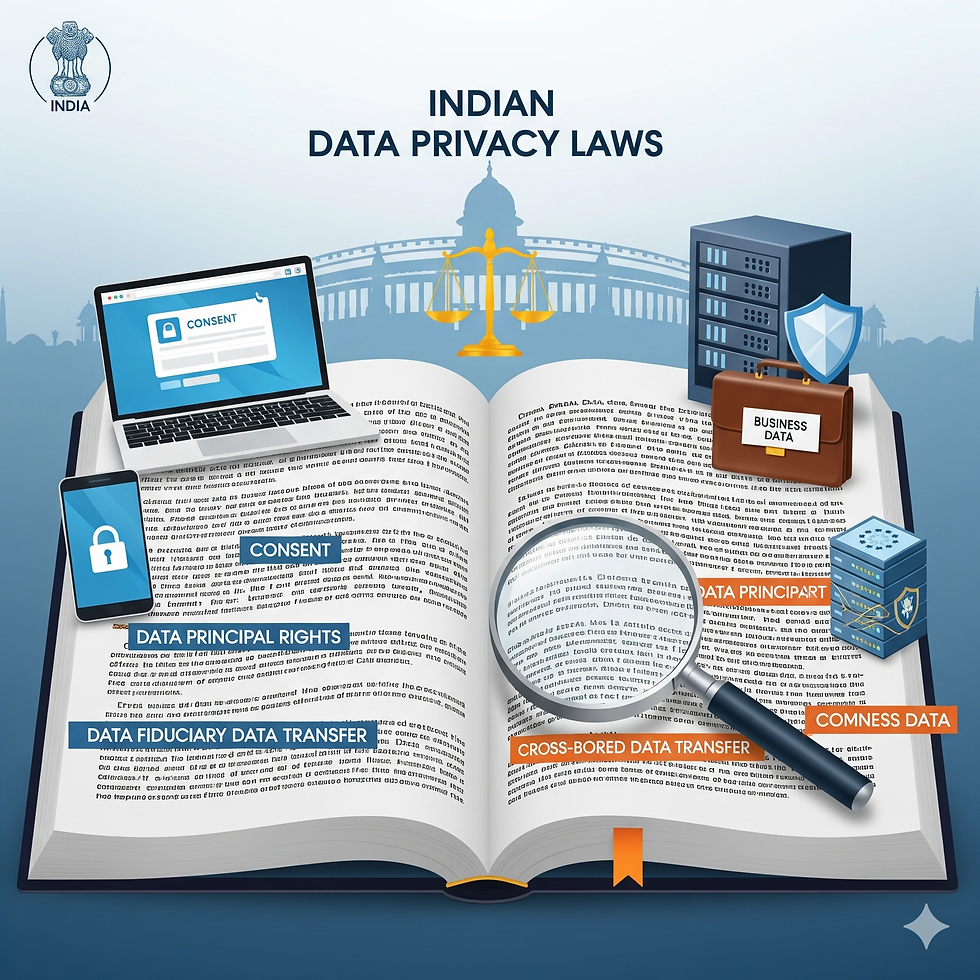
Key Data Privacy Laws in India
1. Digital Personal Data Protection Act, 2023 (DPDP Act)
The DPDP Act is India’s first comprehensive privacy legislation, modeled on global frameworks like the GDPR (EU).
Applicability
Applies to both Indian and foreign entities handling the personal data of Indian citizens.
Covers digital personal data, whether collected online or offline and digitized later.
Key Provisions
Consent-Based Processing: Businesses must obtain free, informed, and explicit consent before collecting personal data.
Data Fiduciary & Processor: Defines roles of businesses (fiduciaries) and third parties (processors).
Rights of Data Principals: Right to access, correct, erase, and withdraw consent.
Obligations of Businesses: Implement security measures, limit data storage, and notify breaches.
Significant Data Fiduciaries: Larger entities must appoint a Data Protection Officer (DPO) and conduct impact assessments.
Penalties: Fines up to ₹250 crore for serious violations.
2. Information Technology Act, 2000 (IT Act) & IT Rules
The IT Act remains the cornerstone of India’s cyber law. While it doesn’t comprehensively cover privacy, it regulates data protection in specific contexts.
Section 43A: Imposes liability on companies for failure to protect sensitive personal data, leading to compensation claims.
IT (Reasonable Security Practices and Procedures and Sensitive Personal Data or Information) Rules, 2011: Requires businesses to adopt security practices, obtain consent, and provide privacy policies.
3. Sector-Specific Regulations
Several industries in India are governed by additional privacy rules:
Financial Sector (RBI Guidelines) – Protect customer banking data, mandate cybersecurity frameworks.
Telecom (TRAI Regulations) – Safeguard customer information against misuse.
Healthcare (DISHA Bill, expected) – Regulates processing of medical and health-related data.
4. Contractual & International Compliance
Businesses working with global clients often need to comply with GDPR, CCPA (California Consumer Privacy Act), or other foreign privacy laws, especially in outsourcing and IT services.
What Businesses Must Do to Comply
1. Obtain Explicit Consent
Businesses must adopt transparent mechanisms for collecting consent. Pre-ticked boxes or vague terms are not valid under the DPDP Act.
2. Draft Strong Privacy Policies
Privacy policies should be:
Easy to understand.
Clear about the type of data collected.
Specific about how data will be used, stored, and shared.
3. Appoint Data Protection Officers (if required)
Large companies or those processing sensitive personal data must designate a Data Protection Officer (DPO) responsible for compliance.
4. Implement Security Measures
Businesses should:
Encrypt personal data.
Regularly update cybersecurity measures.
Conduct penetration tests and audits.
5. Limit Data Retention
Data should only be stored for as long as necessary to fulfill the purpose for which it was collected.
6. Ensure Vendor Compliance
Since many companies outsource IT or cloud services, they must ensure that vendors also follow Indian privacy laws.
7. Breach Notification
Under the DPDP Act, companies must notify the Data Protection Board of India and affected individuals in case of a data breach.
8. Train Employees
Employee negligence is a leading cause of data breaches. Businesses should conduct regular training on data privacy compliance.
Penalties for Non-Compliance
Non-compliance with Indian data privacy laws can be costly:
DPDP Act – Up to ₹250 crore penalty depending on the violation.
IT Act, 2000 – Compensation liability for affected parties.
Sectoral Regulators – Additional fines and suspension of licenses.
Beyond financial penalties, data breaches can cause loss of customer trust, reputational damage, and litigation costs.
Global Comparison – India vs GDPR
Scope: GDPR covers all personal data, while DPDP focuses mainly on digital personal data.
Penalties: GDPR fines are up to 4% of global turnover; DPDP imposes fixed penalties up to ₹250 crore.
Rights: Both laws grant data subjects rights like access, correction, and erasure.
This shows India’s privacy framework is gradually aligning with global standards, impacting businesses engaged in cross-border transactions.
Conclusion
The enactment of the Digital Personal Data Protection Act, 2023 marks a new era in India’s privacy landscape. Businesses can no longer treat data protection as optional—it is now a legal and ethical obligation.
To stay compliant, companies must adopt robust data governance frameworks, secure IT systems, vendor management policies, and transparent customer communication. Proactive compliance will not only avoid penalties but also build customer trust and business credibility.
___________________________________________________________________________________
FAQs
Q1. What is the primary data privacy law in India?
The Digital Personal Data Protection Act, 2023, is India’s primary data privacy law regulating the collection, storage, and use of personal data.
Q2. Do small businesses need to comply with data privacy laws in India?
Yes, all businesses handling personal data must comply, though obligations may vary based on size and data volume.
Q3. What are the penalties for data privacy violations in India?
Fines under the DPDP Act can go up to ₹250 crore, in addition to liability under the IT Act and sectoral regulations.




Comments