Domestic Violence and Legal Remedies in India
- Legal Amenity

- Jan 30
- 4 min read
Introduction
Domestic violence is one of the most pervasive yet underreported human rights violations in India. It cuts across social, economic, educational, and cultural boundaries, affecting millions of individuals, particularly women. Domestic violence is not limited to physical abuse; it also includes emotional, sexual, verbal, and economic abuse that undermines the dignity, safety, and well-being of the victim.
Recognizing the gravity of the issue, Indian law provides a comprehensive legal framework to protect victims and offer remedies against domestic violence. This blog provides an in-depth analysis of domestic violence laws in India, especially the Protection of Women from Domestic Violence Act, 2005 (PWDVA), available legal remedies, judicial interpretations, and the challenges in enforcement.
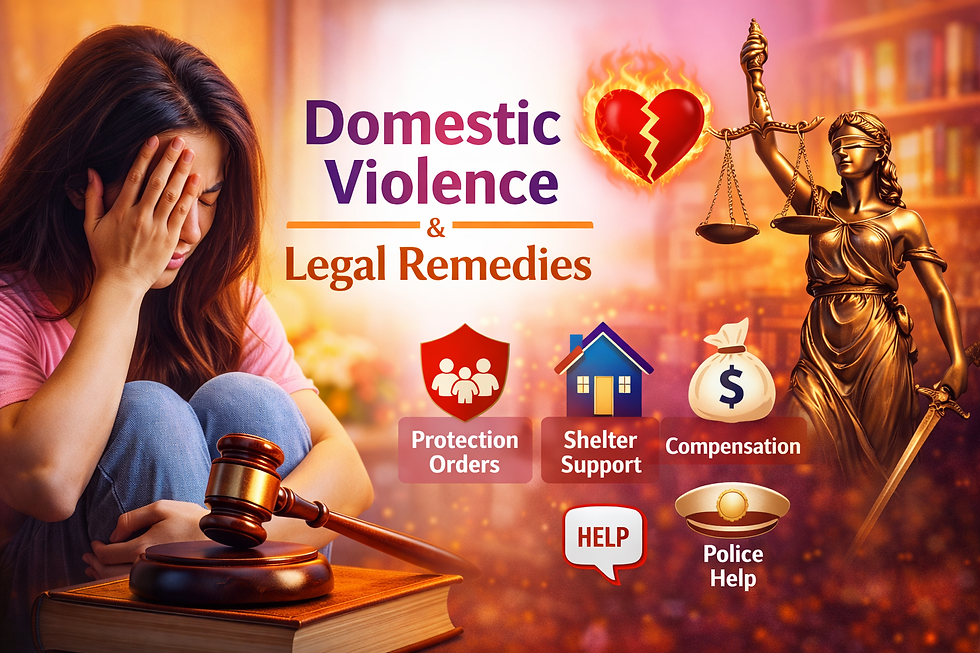
Understanding Domestic Violence
Domestic violence refers to any act or omission by a person in a domestic relationship that causes harm, injury, or endangers the health, safety, life, or well-being of another person. Unlike traditional notions, domestic violence is not confined to physical cruelty.
Forms of Domestic Violence
Under Indian law, domestic violence includes:
Physical abuse: Assault, bodily harm, or use of force
Emotional or verbal abuse: Insults, humiliation, threats, character assassination
Sexual abuse: Forced sexual acts, marital sexual violence
Economic abuse: Denial of financial resources, disposal of assets, restricting employment
This broad definition ensures that victims are protected from all forms of cruelty within domestic relationships.
Legal Framework Governing Domestic Violence in India
Protection of Women from Domestic Violence Act, 2005
The Protection of Women from Domestic Violence Act, 2005 is the primary legislation addressing domestic violence in India. It was enacted to provide effective protection to women from violence occurring within the household.
Key features of the Act include:
Protection orders
Residence orders
Monetary relief
Custody orders
Compensation orders
The Act adopts a civil law approach with immediate reliefs, without excluding criminal remedies.
Who Is Protected Under the Act?
The PWDVA protects:
Women who are married
Women in live-in relationships
Mothers, sisters, widows, and other female relatives
The term "domestic relationship" includes relationships by marriage, consanguinity, adoption, or relationships in the nature of marriage. This inclusive approach reflects the evolving social realities in India.
What Constitutes a Shared Household?
A shared household refers to a household where the aggrieved person lives or has lived in a domestic relationship. Courts have clarified that a woman’s right to residence cannot be denied merely because she does not have ownership rights over the property.
In S.R. Batra v. Taruna Batra (2007), the Supreme Court initially took a restrictive view, but later judgments adopted a more liberal interpretation to strengthen women’s right to residence.
Legal Remedies Available to Victims
Protection Orders
Courts can issue protection orders restraining the respondent from committing any act of domestic violence, contacting the victim, or visiting her workplace.
Residence Orders
Victims have the right to reside in the shared household. Courts may:
Restrain dispossession
Direct alternative accommodation
Prevent alienation of property
Monetary Relief
Courts may grant monetary relief to meet expenses incurred due to domestic violence, including:
Medical expenses
Loss of earnings
Maintenance for the aggrieved woman and children
Custody Orders
Temporary custody of children may be granted to the aggrieved woman, keeping the child’s welfare as the paramount consideration.
Compensation Orders
Courts may award compensation for mental torture, emotional distress, and physical injuries suffered due to domestic violence.
Role of Protection Officers and Service Providers
The Act provides for the appointment of Protection Officers who assist victims in:
Filing domestic incident reports
Accessing medical and legal aid
Securing shelter homes
Registered service providers and NGOs play a crucial role in rehabilitation and support.
Criminal Remedies Alongside Civil Relief
While the PWDVA is primarily civil in nature, domestic violence can also attract criminal liability under:
Section 498A IPC - Cruelty by husband or relatives
Section 323 IPC - Voluntarily causing hurt
Section 506 IPC - Criminal intimidation
Victims may pursue civil relief under the PWDVA and criminal prosecution simultaneously.
Domestic Violence and Constitutional Rights
Domestic violence violates fundamental rights guaranteed under the Constitution, including:
Article 14 – Right to equality
Article 15 – Protection against discrimination
Article 21 – Right to life and dignity
Courts have recognized that protection from domestic violence is integral to ensuring a dignified life.
Key Judicial Pronouncements
Indra Sarma v. V.K.V. Sarma (2013)
The Supreme Court recognized live-in relationships under the PWDVA and laid down guidelines to determine relationships in the nature of marriage.
Hiral P. Harsora v. Kusum Narottamdas Harsora (2016)
The Court struck down the words “adult male” from the Act, allowing complaints against female relatives as well.
Shalini v. Kishor (2015)
The Court emphasized speedy disposal of domestic violence cases to ensure timely justice.
Challenges in Implementation
Despite a strong legal framework, challenges persist:
Social stigma and fear of retaliation
Lack of awareness about legal rights
Delays in court proceedings
Inadequate infrastructure and protection officers
Addressing these challenges requires legal awareness, sensitivity training, and institutional support.
Way Forward
To effectively combat domestic violence:
Laws must be implemented in letter and spirit
Victims must have easy access to legal aid
Fast-track courts and digital filing mechanisms should be promoted
Society must actively challenge patriarchal norms
Legal remedies alone are not enough; social change is equally essential.
Conclusion
Domestic violence is not a private matter but a serious violation of human and constitutional rights. Indian law, particularly the Protection of Women from Domestic Violence Act, 2005, provides comprehensive remedies to protect victims and restore dignity. Effective enforcement, judicial sensitivity, and public awareness are crucial to ensuring that the law serves its intended purpose.
___________________________________________________________________________________
FAQs
Q1. What law protects women from domestic violence in India?
The Protection of Women from Domestic Violence Act, 2005 provides civil remedies and protection to women facing domestic abuse.
Q2. Can a woman file a domestic violence case without physical abuse?
Yes, emotional, verbal, sexual, and economic abuse are also recognized as domestic violence under the law.
Q3. Can criminal cases be filed along with a domestic violence complaint?
Yes, victims can pursue criminal remedies under the IPC along with civil relief under the PWDVA.




Comments