Essential Contracts Every Startup Must Have (NDA, Vendor, Employee, Client)
- Legal Amenity

- Oct 7, 2025
- 3 min read
Introduction
Every startup begins with passion, vision, and risk-taking. But without strong contracts, even the best ideas can collapse due to disputes, IP theft, or financial losses. Legal documentation ensures clarity, accountability, and protection for founders, employees, and clients.
Startups often ignore contracts in the early stages, relying on verbal promises or informal notes. Unfortunately, this leads to conflicts, lawsuits, and loss of investor trust. To build a legally sound foundation, every startup must have essential contracts in place.
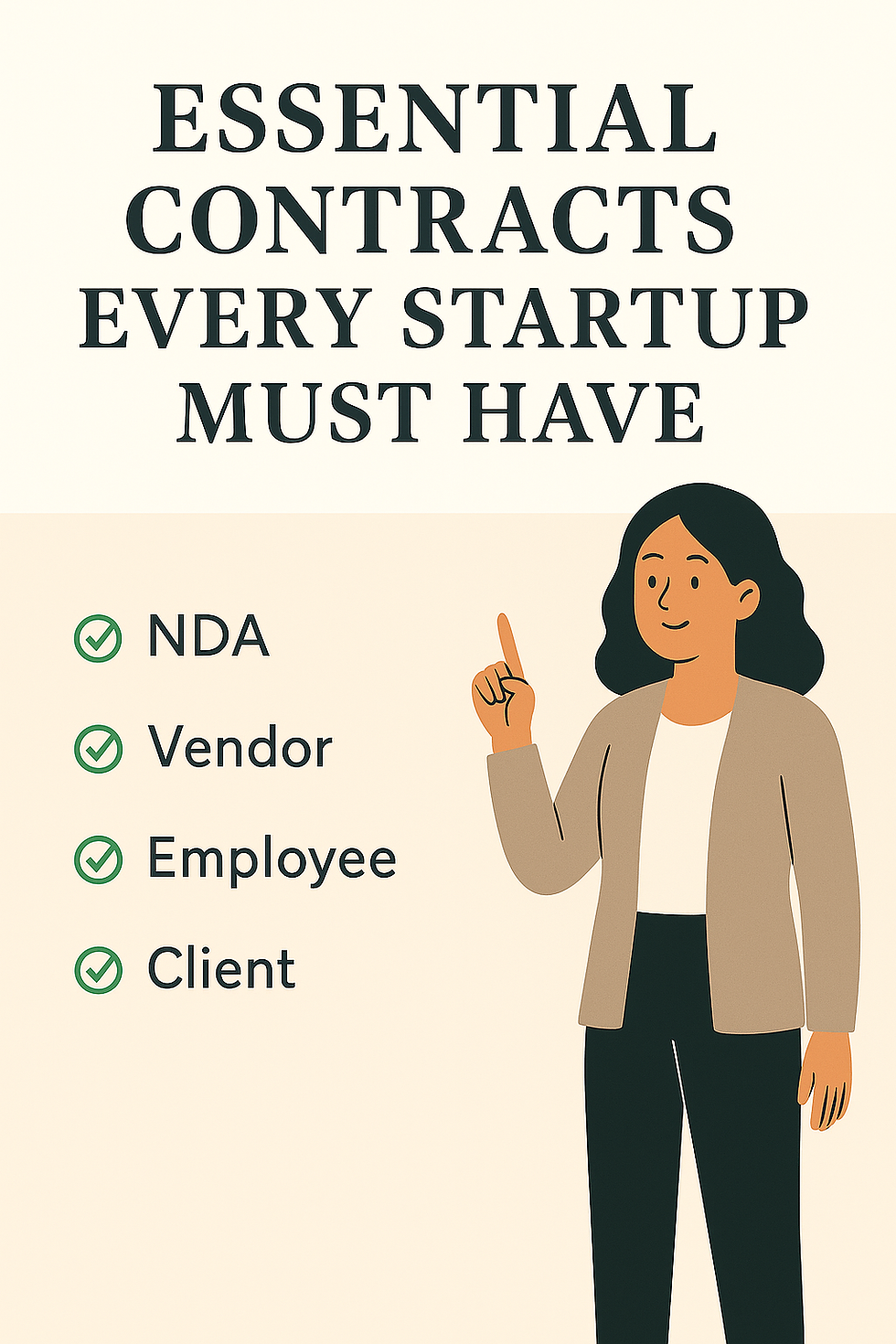
This blog covers the four most critical contracts every startup must have: Non-Disclosure Agreements (NDA), Vendor Agreements, Employee Contracts, and Client Contracts.
1. Non-Disclosure Agreement (NDA)
Why it’s important
An NDA is essential for protecting confidential information. Startups often share sensitive data—business models, financials, prototypes, client lists—with employees, vendors, and investors. Without an NDA, there’s a high risk of data leakage or misuse.
Key Clauses to Include
Definition of Confidential Information – What counts as confidential.
Obligations of Receiving Party – Restrictions on disclosure and use.
Exclusions – Information already public or independently developed.
Duration – Period for which confidentiality applies.
Consequences of Breach – Remedies, penalties, or injunctions.
Example: A startup pitching to investors signs NDAs to ensure its idea is not copied or leaked.
2. Vendor Agreement
Why it’s important
Vendors play a vital role in supplying raw materials, services, or technology. Without a written vendor agreement, startups face risks like late deliveries, hidden costs, or poor-quality supplies.
Key Clauses to Include
Scope of Work – Clear deliverables, timelines, and standards.
Pricing & Payment Terms – Mode, schedule, penalties for delay.
Liability & Indemnity – Protection from vendor negligence.
Termination Clause – Exit options in case of non-performance.
Dispute Resolution – Arbitration or jurisdiction in case of conflict.
Example: An e-commerce startup hires a packaging supplier. A vendor agreement ensures quality standards and delivery timelines are legally enforceable.
3. Employee Agreement
Why it’s important
Employees are the backbone of startups, but without contracts, disputes over salaries, roles, or intellectual property may arise. An employment agreement protects both employer and employee.
Key Clauses to Include
Job Role & Responsibilities – Prevents ambiguity.
Compensation & Benefits – Salary structure, bonuses, incentives.
Termination & Notice Period – Legal grounds and notice requirements.
Confidentiality & IP Assignment – Ensures all work belongs to the company.
Non-Compete & Non-Solicit Clauses – Prevents employees from competing or poaching clients.
Example: A SaaS startup hires a software developer. An employee contract ensures the code written belongs to the company, not the individual.
4. Client Agreement
Why it’s important
Clients generate revenue, but vague terms often lead to disputes over payments or services. A client agreement defines expectations and protects cash flow.
Key Clauses to Include
Scope of Services – Clear deliverables, timelines, and milestones.
Payment Terms – Advance, installment, or milestone-based payments.
Confidentiality & Data Protection – Especially critical for IT and consulting firms.
Limitation of Liability – Caps damages the startup may owe.
Termination & Renewal – Smooth exit or renewal process.
Example: A digital marketing startup signs client agreements to avoid late payments and ensure accountability.
Why These Contracts Matter for Startups
Legal Protection – Contracts are enforceable in court.
Investor Confidence – Well-documented contracts attract funding.
Risk Mitigation – Prevents financial and reputational losses.
Operational Clarity – Avoids conflicts by setting expectations.
Startups with proper documentation are far more likely to scale smoothly than those relying on informal arrangements.
Common Mistakes Startups Make with Contracts
Using Generic Templates – Missing key clauses specific to business needs.
Skipping NDAs – Leading to IP theft or data leaks.
Unclear Payment Terms – Causing cash flow problems.
Ignoring Employment Laws – Risking labour disputes and penalties.
Not Reviewing Agreements Regularly – Outdated clauses can cause compliance issues.
Best Practices for Startups
Draft contracts with professional legal help instead of copy-paste templates.
Discuss terms transparently with vendors, employees, and clients.
Include arbitration or mediation clauses to avoid lengthy litigation.
Digitally store contracts for easy access and compliance.
Review and update contracts annually as business needs evolve.
Conclusion
Startups often fail not because of bad ideas, but due to poor legal foundations. Contracts and documentation are the shield that protects businesses from disputes, financial risks, and compliance penalties.
At the very least, every startup must have four essential contracts in place:
NDA (Non-Disclosure Agreement) – To protect sensitive information.
Vendor Agreement – To ensure smooth supply and service chains.
Employee Agreement – To safeguard employment terms and IP ownership.
Client Agreement – To define deliverables, payments, and responsibilities.
Investing in strong contracts today ensures your startup grows securely tomorrow.
___________________________________________________________________________________
FAQs
1. Why do startups need NDAs?
NDAs protect confidential information, preventing misuse or leakage by employees, vendors, or investors.
2. Are employee contracts legally mandatory?
Yes, under Indian labour laws, written employment contracts help avoid disputes and ensure compliance.
3. Can startups rely on online contract templates?
Not advisable, generic templates often miss crucial clauses and may not comply with Indian law.



Comments