Founder Agreements & Equity: A Complete Guide for Startups
- Legal Amenity

- Sep 24, 2025
- 3 min read
Introduction
Starting a business with co-founders is exciting, but without a clear Founder Agreement, the road ahead can get complicated. From equity distribution to decision-making powers, many startups face disputes because they skip this crucial step. A well-drafted Founder Agreement acts as the legal backbone of a startup, defining ownership, responsibilities, and future rights.
This blog explores Founder Agreements & Equity distribution in startups, their importance, key clauses, mistakes to avoid, and practical tips for drafting them.
What is a Founder Agreement?
A Founder Agreement is a legally binding contract among startup founders that defines:
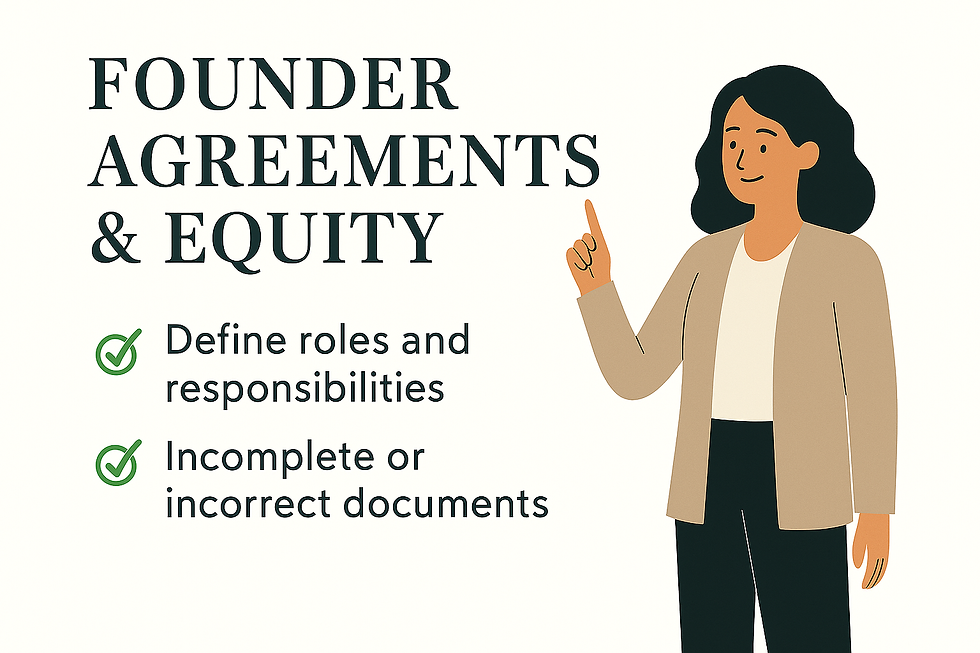
Roles & responsibilities of each founder.
Equity split and ownership structure.
Decision-making authority in business operations.
Exit clauses if a founder leaves.
Intellectual property (IP) ownership.
Think of it as a prenuptial agreement for startups—it ensures clarity, reduces disputes, and secures the company’s growth trajectory.
Why is a Founder Agreement Important?
Many startups collapse due to internal conflicts rather than external challenges. A Founder Agreement:
Avoids Disputes – Prevents misunderstandings over ownership and responsibilities.
Ensures Fair Equity Split – Recognizes contributions like capital, skills, and networks.
Protects Intellectual Property – Ensures all IP developed belongs to the company.
Boosts Investor Confidence – Investors want clarity on shareholding and governance.
Defines Exit Scenarios – Prevents chaos if a founder quits or is removed.
Key Elements of a Founder Agreement
1. Equity Distribution (Shareholding Structure)
Equity is the most sensitive topic in startups. Founders must agree on:
Initial shareholding percentage.
Vesting schedules (shares earned over time).
Dilution terms if new investors join.
Example: A typical equity split may follow contribution value: Idea (10–15%), Capital (30–40%), Skills/Execution (40–50%).
2. Roles & Responsibilities
Each founder’s role must be defined clearly:
CEO – Strategic vision & fundraising.
CTO – Technology development & product innovation.
COO – Operations & business execution.
This prevents overlap and accountability gaps.
3. Decision-Making & Voting Rights
Startups face critical decisions like raising funds, entering partnerships, or pivoting business models. The agreement should specify:
Voting rights (equal or based on equity share).
Reserved matters requiring unanimous approval.
Board composition and control.
4. Intellectual Property (IP) Ownership
All products, designs, patents, or code created must belong to the company, not individuals. This avoids future conflicts if a founder exits.
5. Vesting & Lock-In Clauses
Equity should not be given up front without conditions. Vesting ensures founders earn shares over time (e.g., 4 years with a 1-year cliff). This prevents situations where a founder leaves early but retains full ownership.
6. Compensation & Benefits
Founders may start without salaries, but the agreement should outline:
Future salary structures.
Expense reimbursements.
Dividend or profit-sharing policies.
7. Exit, Removal & Dissolution Clauses
To protect business continuity, agreements should cover:
What happens if a founder quits voluntarily.
Forced exit in case of misconduct or non-performance.
Distribution of assets in case of dissolution.
Common Mistakes Startups Make with Founder Agreements
Skipping Legal Drafting – Relying on verbal promises or informal notes.
Unequal or Unfair Equity Split – Not accounting for future contributions.
No Vesting Clause – Leading to “free-rider founders” who leave early.
Ignoring Exit Scenarios – No clarity on buyback, valuation, or IP transfer.
Not Updating Agreements – Startups evolve, and so should founder agreements.
Founder Equity: How Should Startups Split Ownership?
Equity distribution depends on multiple factors:
Capital Contribution – Founders investing money usually hold higher stakes.
Time & Effort – Active founders deserve more equity than passive ones.
Domain Expertise – Unique skills and industry experience matter.
Risk Appetite – Those taking higher financial or career risks may claim bigger shares.
How Founder Agreements Attract Investors
Investors look for legal certainty. A well-structured agreement:
Shows professionalism and risk management.
Protects against founder disputes (a major red flag).
Provides clarity on ownership structure and dilution.
Ensures IP rights belong to the company, not individuals.
Practical Tips for Drafting a Founder Agreement
Seek Professional Legal Help – Templates may miss key clauses.
Discuss Equity Early – Avoid conflicts by negotiating upfront.
Include Vesting & Exit Provisions – Future-proof the startup.
Update Regularly – Revise the agreement as the business scales.
Align with Company Incorporation Documents – Ensure consistency with Articles of Association and shareholder agreements.
Conclusion
A startup may begin with passion, but long-term success requires legal clarity. Founder Agreements & Equity distribution form the foundation of trust and governance in startups. Without them, even promising ventures risk disputes and collapse.
Invest time in drafting a founder agreement with expert legal guidance—it’s not just a document, it’s a shield for your startup’s future.
___________________________________________________________________________________
FAQs
1. What is a Founder Agreement in a startup?
It is a legal contract defining equity, roles, responsibilities, and exit terms among co-founders.
2. How should equity be split among founders?
Equity should be based on contribution—capital, skills, time, and risk—with vesting to ensure fairness.
3. Is a Founder Agreement necessary for small startups?
Yes, even small startups need it to avoid conflicts and attract future investors.



Comments