Licensing vs. Assignment Contracts: Understanding IP Agreements

Introduction
In a digital and innovation-driven economy, intellectual property (IP) is one of the most valuable business assets. Whether it's a patent, trademark, copyright, or design, IP can be monetized, licensed, sold, or transferred—but the legal structure you choose can dramatically affect your rights and revenue.
Two common legal tools to manage IP ownership and usage are Licensing Agreements and Assignment Contracts.
This blog explains the differences between licensing and assignment, their legal implications in India, and how to choose the right agreement depending on your business goals.
What is an IP Licensing Agreement?
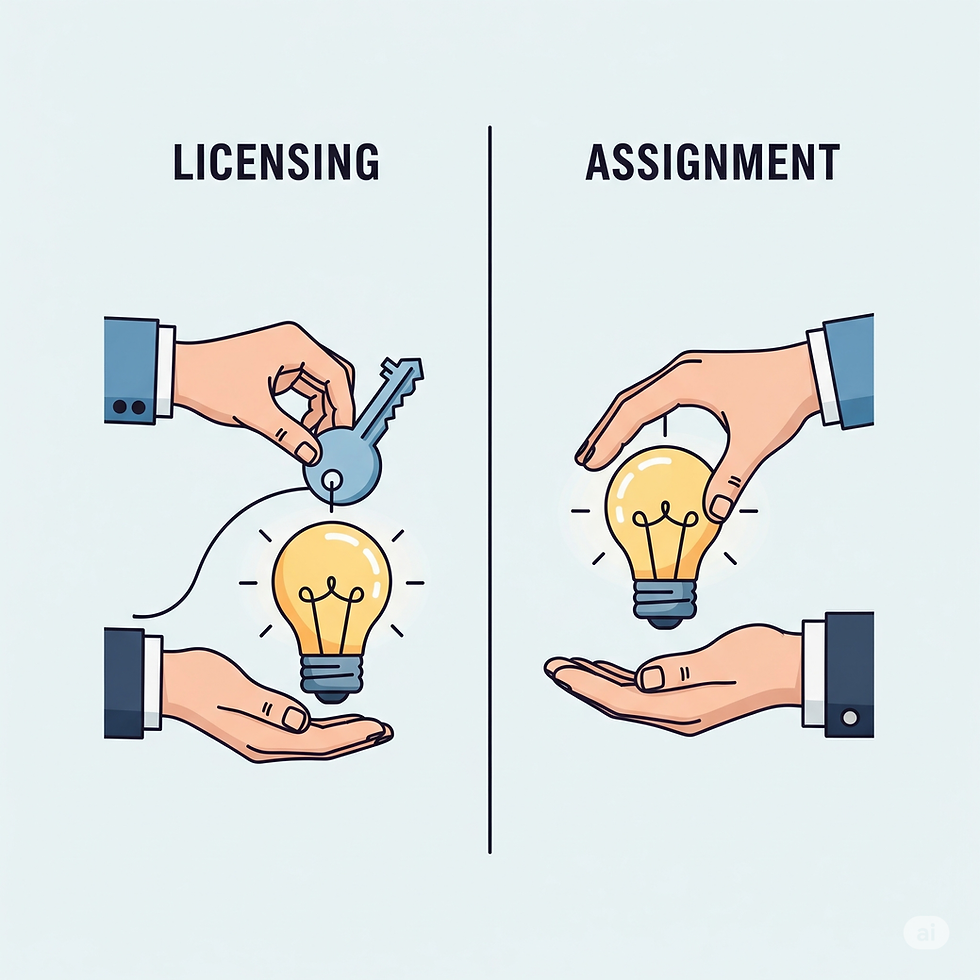
A Licensing Agreement is a contract in which the owner (licensor) of IP grants permission to another party (licensee) to use the intellectual property under specific terms and conditions, without transferring ownership.
Key Features:
Ownership remains with the licensor
Licensee uses IP for a defined purpose and duration
The license can be exclusive, non-exclusive, or sole
Includes royalty payments or fees
Common in software, branding, music, and franchises
What is an IP Assignment Agreement?
An Assignment Agreement is a contract in which the owner of the IP (assignor) permanently transfers all ownership rights to the assignee. It’s similar to selling a property.
Key Features:
Complete transfer of ownership
No residual rights for the assignor
Usually, a one-time payment
Used in M&A, IP acquisition, or sale of brands/startups
Licensing vs. Assignment: Key Differences
Feature | Licensing Agreement | Assignment Agreement |
Ownership | Remains with licensor | Fully transferred to the assignee |
Duration | Temporary or fixed-term | Permanent |
Royalties or Consideration | Ongoing (e.g., royalties) | Usually, a one-time payment |
Rights Granted | Limited rights to use | Full ownership and control |
Revocability | Can be revocable | Irrevocable |
Common Use Cases | Software, brands, creative works | Sale of patents, trademarks, and companies |
Legal Framework in India
In India, IP contracts are governed by the following statutes:
For Copyright:
Copyright Act, 1957
Assignment must be in writing and specify the work, duration, and territory
For Trademarks:
Trade Marks Act, 1999
Assignment or license must be recorded with the Trade Marks Registry for enforcement
For Patents:
Patents Act, 1970
Licenses and assignments must be registered with the Patent Office
For Designs:
Designs Act, 2000
Similar registration formalities to patents and trademarks
All agreements must also comply with the Indian Contract Act, 1872 to be valid and enforceable.
Types of Licensing Agreements
1. Exclusive License
Only the licensee has the right to use the IP. Even the licensor is excluded.
2. Non-Exclusive License
Licensor can grant rights to multiple licensees at the same time.
3. Sole License
Only one licensee, but the licensor can still use the IP themselves.
4. Compulsory License (specific to patents)
Issued by the government in special cases (e.g., public health), overriding the owner's exclusive rights.
Key Clauses in IP Licensing and Assignment Agreements
Whether drafting a licensing or assignment contract, always include:
1. Identification of IP
Clearly describe the IP asset—registration number, title, description, and ownership.
2. Grant of Rights
Specify whether the rights are being licensed or assigned, along with:
Scope (what is allowed)
Duration
Territory
3. Consideration
State how the licensee/assignee will compensate the licensor/assignor:
Royalties
Lump-sum payments
Performance-based incentives
4. Confidentiality
Ensure trade secrets and proprietary data remain protected during and after the agreement.
5. Warranties and Indemnities
Declare that:
The IP is original and unencumbered
The licensor/assignor has the authority to license/assign
Indemnity against third-party infringement claims
6. Termination Clause
Specify conditions for termination:
Breach of contract
Non-payment
Expiry of term
7. Dispute Resolution
Include governing law (typically Indian law), jurisdiction, and method (e.g., arbitration).
Common Mistakes to Avoid
Unclear definition of the IP being transferred or licensed
Failing to register the assignment or license with the appropriate authority
Not specifying royalty structure or payment terms
Omitting territory or exclusivity clauses
Not conducting IP due diligence before signing
Choosing the Right Agreement: Licensing vs. Assignment
Your Objective | Recommended Agreement |
You want to earn recurring income while keeping ownership | License |
You want to sell the IP outright | Assignment |
You want to test market potential of your brand or content | License |
You are merging, acquiring or transferring a company with its IP | Assignment |
You need temporary permission to use someone else’s brand or IP | License |
Best Practices
Always use written contracts, not oral agreements
Customize the contract for each type of IP
Ensure registration with the relevant IP authorities
Maintain audit rights in licensing agreements
Consult an IP attorney for cross-border transactions or complex ownership structures
Real-World Use Cases
Software Company
Licenses its code to clients with non-exclusive rights for annual fees.
Startup Acquisition
Assigns its patents and branding assets to the acquiring company.
Franchise Chain
Licenses its brand and logo to franchisees while retaining ownership.
Conclusion
Whether you're an inventor, software developer, brand owner, or artist, understanding the difference between licensing and assignment is essential to protect your rights and maximize the value of your intellectual property. One gives you control of cash flow, the other gives you a clean exit with full ownership transfer.
Make sure you consult a legal expert to draft, review, and register your IP agreements the right way—because in the world of IP, what you sign is what you own (or give up).
_________________________________________________________________________________
FAQs
Q1: Is it mandatory to register an IP assignment in India?
Yes, for patents, trademarks, and designs, registration with the relevant authority is necessary to make the transfer legally effective.
Q2: Can a licensee sell the IP to someone else?
No, unless the agreement specifically allows it. Licenses are usually non-transferable.
Q3: Is licensing more common than assignment in IP law?
Yes. Licensing is more flexible and preferred for commercializing IP without giving up ownership.




Comments