Virtual Courts and E-Litigation: The Future of Justice Delivery in India

Introduction
The Indian judicial system has long been criticized for delays, procedural complexity, and access barriers. With more than four crore pending cases, traditional courtrooms alone are no longer sufficient to meet the demands of a modern democracy. The emergence of Virtual Courts and E-Litigation marks a transformative shift in how justice is accessed, delivered, and administered in India.
Accelerated by the COVID-19 pandemic, virtual courts have moved from being an experimental reform to a mainstream judicial mechanism. Video conferencing, e-filing, digital records, and online hearings have redefined litigation practices for advocates, litigants, and judges alike. This blog explores the concept, evolution, legal framework, advantages, challenges, and future of virtual courts and e-litigation in India.
What Are Virtual Courts?
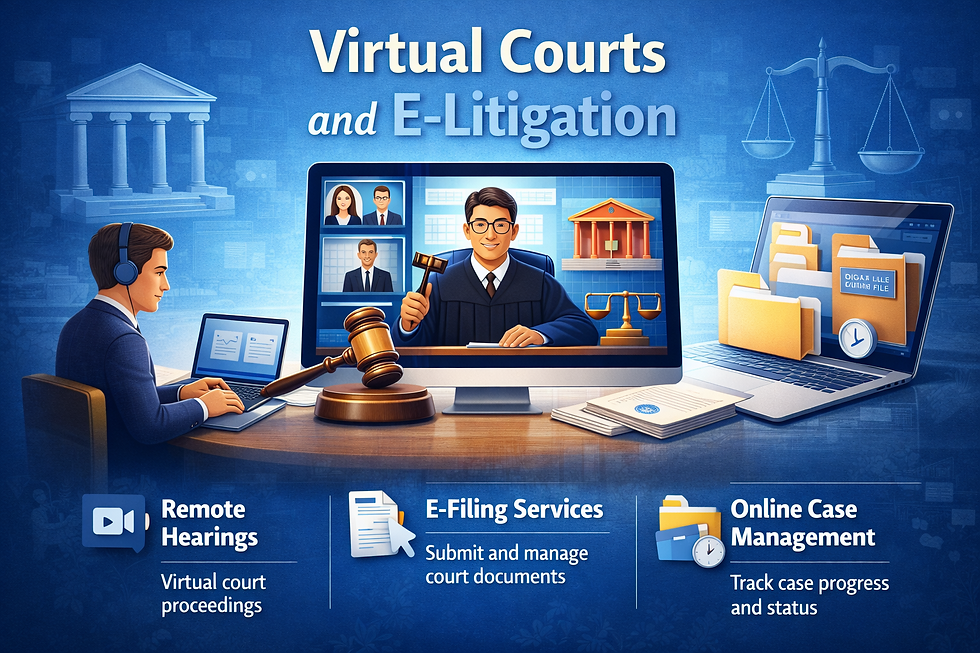
Virtual courts are judicial forums where court proceedings are conducted through electronic and digital platforms instead of physical courtrooms. These courts rely on video conferencing, online document submission, digital case management systems, and electronic orders.
Unlike traditional courts, virtual courts may:
Function without physical infrastructure
Decide cases based on digital records
Allow parties to appear remotely
Enable automated or paperless adjudication in certain categories of cases
In India, virtual courts initially focused on traffic challans and minor offences, but their scope has significantly expanded to include civil, criminal, commercial, and constitutional matters.
Understanding E-Litigation
E-litigation refers to the end-to-end digital conduct of litigation, including:
E-filing of pleadings and documents
Online case allocation and listing
Virtual hearings via video conferencing
Digital evidence submission
E-orders, e-judgments, and e-certified copies
E-litigation does not eliminate courts; rather, it digitizes the litigation lifecycle, making justice faster, more transparent, and more accessible.
Evolution of Virtual Courts in India
India’s journey toward digital justice began much before the pandemic. The e-Courts Project, launched under the National e-Governance Plan, laid the foundation for court digitization.
However, virtual courts gained real momentum after directions issued by the Supreme Court of India in 2020, recognizing video conferencing as a valid mode for court proceedings. What began as an emergency response soon evolved into a permanent judicial reform.
High Courts across India framed Video Conferencing Rules, standardizing virtual hearing procedures and ensuring procedural fairness.
Legal Framework Governing Virtual Courts and E-Litigation
Virtual courts in India operate within an established legal and constitutional framework:
1. Constitutional Validity
Article 21 of the Indian Constitution guarantees the right to access justice. Virtual courts enhance this right by reducing geographical, financial, and logistical barriers.
2. Procedural Laws
Civil Procedure Code, 1908
Criminal Procedure Code, 1973
Commercial Courts Act, 2015
Courts have interpreted these laws flexibly to accommodate electronic filings, digital evidence, and remote hearings.
3. Information Technology Act, 2000
The IT Act gives legal recognition to:
Electronic records
Digital signatures
Online communication
This forms the backbone of e-litigation and virtual adjudication.
Key Features of Virtual Courts and E-Litigation
1. E-Filing Systems
Advocates and litigants can file plaints, written statements, applications, and affidavits online, eliminating physical queues and paperwork.
2. Video Conferencing Hearings
Cases are heard through secure platforms allowing judges, lawyers, and parties to join from different locations.
3. Digital Case Management
Case status, hearing dates, orders, and judgments are available online through centralized portals.
4. Paperless Courts
Court records are maintained electronically, reducing storage costs and document loss.
Advantages of Virtual Courts in India
1. Faster Justice Delivery
Virtual courts significantly reduce adjournments caused by non-appearance, travel delays, or logistical constraints.
2. Cost Efficiency
Litigants save on travel, accommodation, and incidental expenses. Lawyers can attend multiple courts virtually in a single day.
3. Improved Access to Justice
Remote hearings enable participation by:
Rural litigants
Senior citizens
Persons with disabilities
NRIs and foreign parties
4. Transparency and Accountability
Digital records, time-stamped filings, and online cause lists improve judicial transparency.
5. Environmental Benefits
Reduced paper usage and travel contribute to sustainable judicial practices.
Role of Virtual Courts in Commercial and Corporate Litigation
Virtual courts have proven particularly effective in:
Commercial disputes
Arbitration-related matters
Insolvency proceedings
Contract enforcement cases
For businesses, e-litigation ensures predictability, speed, and reduced compliance burden, making India a more arbitration- and business-friendly jurisdiction.
Virtual Courts and Criminal Justice
In criminal matters, virtual courts are commonly used for:
Remand hearings
Bail applications
Production of under-trial prisoners
Recording of procedural evidence
This reduces security risks, prisoner transportation costs, and administrative delays, while safeguarding procedural fairness.
Challenges and Limitations of Virtual Courts
Despite their advantages, virtual courts face several challenges:
1. Digital Divide
Limited internet access, lack of devices, and poor connectivity in rural areas hinder equal participation.
2. Data Privacy and Cybersecurity
Sensitive judicial data must be protected from hacking, leaks, and unauthorized access.
3. Open Court Principle
Ensuring public access and transparency in virtual hearings remains a concern.
4. Advocacy and Trial Limitations
Cross-examination, witness demeanor assessment, and complex trial advocacy are less effective in virtual settings.
Impact on Lawyers and Legal Practice
Virtual courts have transformed legal practice by:
Encouraging tech-driven lawyering
Increasing efficiency in case management
Creating opportunities for remote practice
Reducing dependence on physical proximity to courts
Lawyers now require not only legal knowledge but also digital competence to remain competitive.
Future of Virtual Courts in India
The future of virtual courts lies in hybrid justice systems, combining physical and virtual hearings. Likely developments include:
AI-assisted case management
Virtual mediation and arbitration platforms
Blockchain-based evidence storage
Fully paperless courts
Virtual courts are not a temporary solution but a permanent pillar of judicial reform in India.
Conclusion
Virtual courts and e-litigation represent a paradigm shift in the Indian justice delivery system. By leveraging technology, courts can reduce pendency, enhance access, and improve efficiency without compromising fairness or legality.
While challenges remain, continued investment in digital infrastructure, cybersecurity, and judicial training will ensure that virtual courts become more inclusive, reliable, and effective. The future of justice is not confined to courtrooms—it is digital, accessible, and evolving.
___________________________________________________________________________________
FAQs
Q1. Are virtual court hearings legally valid in India?
Yes, virtual hearings are legally valid and recognized by courts under constitutional and procedural laws.
Q2. Can all cases be heard through virtual courts?
No, complex trials may require physical hearings, but procedural, commercial, and interim matters are commonly heard virtually.
Q3. Is e-filing mandatory in Indian courts?
In many courts, e-filing is mandatory or strongly encouraged, especially in High Courts and commercial matters.




Comments